
An intervention to enhance navigational safety at the entrance to the Ría de Camariñas
Mediterráneo Señales Marítimas (MSM) has carried out the upgrade of the lighting equipment of the Punta do Lago leading line, located at the entrance to the Ría de Camariñas in A Coruña, Spain.

The Punta do Lago leading line consists of two navigation marks, officially identified as 03830 and 03831 in the nomenclature of the Spanish Hydrographic Institute (IHM). These are twin 8-metre-high towers that serve as an alignment reference for vessels approaching the estuary.
During daytime, both structures must be visually aligned from the sea in order to indicate the correct inbound navigation track. This alignment is made possible by their topographic arrangement: the rear structure is positioned at a higher elevation, allowing both marks to visually overlap when observed from a vessel on the correct heading.
At night, the leading function is provided by the light installed on structure 03830, the mark closest to the sea.

The leading line is a key reference for guiding mariners during the approach to the estuary, in an area where the presence of submerged rocky shoals conditions inbound manoeuvres.
Upgrade of the legacy lighting system
The previous system was based on a conventional lamp fitted with an external optical assembly composed of coloured glass elements, responsible for generating the different navigational light sectors.
Due to the deterioration of the system over time and the need to modernise the signalling equipment, the decision was made to replace the legacy solution with a next-generation LED sector light, offering improved reliability, optical precision and reduced maintenance requirements.

MSM solution: MBL400S Sector Light
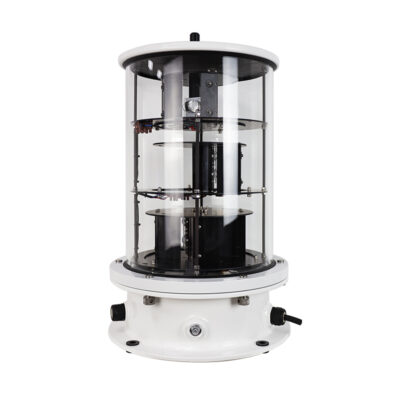
For this project, MSM supplied an MBL400S sector light specifically configured to reproduce the sectors defined in the original signal.
The MBL400S is an LED sector light designed for Aids to Navigation (AtoN) applications requiring high optical precision and accurate sector definition. In this installation, the system was configured with three levels and a total of five sectors, with angular precision better than 0.05° between transitions:
- White: 63.5°
- Green: 14.8°
- White: 1.3°
- Red: 30.2°
- White: 74.2°
The narrow 1.3° white sector marks the inbound heading of 108.5°, providing mariners with a precise reference during the approach to the estuary.

In terms of luminous range, the system provides a 6 nautical mile range for the white light, while the red and green sectors offer a nominal range of 4 nautical miles, adapting to the signalling requirements of each sector.

This upgrade improves optical stability and energy efficiency, while significantly reducing the presence of mechanical and optical components subject to wear, typical of legacy lamp-and-external-filter systems.
Installation, configuration and validation works
The installation of the new equipment was accompanied by configuration, alignment and validation works for the light sectors.
This process is particularly critical in sector lights, as the exact transition between colours must match the designated navigational bearings and safety zones.
Validation and verification tests were carried out in coordination with the Maritime Signals technical team of the Port Authority of A Coruña, including onboard checks along the approach routes to ensure correct sector definition and proper signal perception under real navigation conditions.

Conclusion
The upgrade of the Punta do Lago leading line lighting system enhances the reliability of a key navigational aid at the entrance to the Ría de Camariñas.

The incorporation of LED technology enables more precise sector definition and greater system stability under real operating conditions.
This intervention contributes to keeping maritime signalling up to date in an area where precision during approach is critical for navigational safety