
Introduction: when a wreck becomes a new danger
Wrecks and new dangers represent one of the most critical threats to maritime traffic safety in port environments. A sunken vessel, a submerged or partially emerging object, or a structure displaced after an accident can become invisible obstacles to navigation, increasing the risk of collisions, groundings, material damage, operational disruptions and legal liabilities for the competent authorities.
For this reason, wreck marking should not be understood as a one-off reactive action, but as an essential part of preventive maritime safety management. Having prepared resources, such as a wreck beacon and an appropriate wreck buoy, allows port authorities and responsible organizations to act quickly, ensuring the immediate visibility of the hazard and the protection of access and manoeuvring routes.
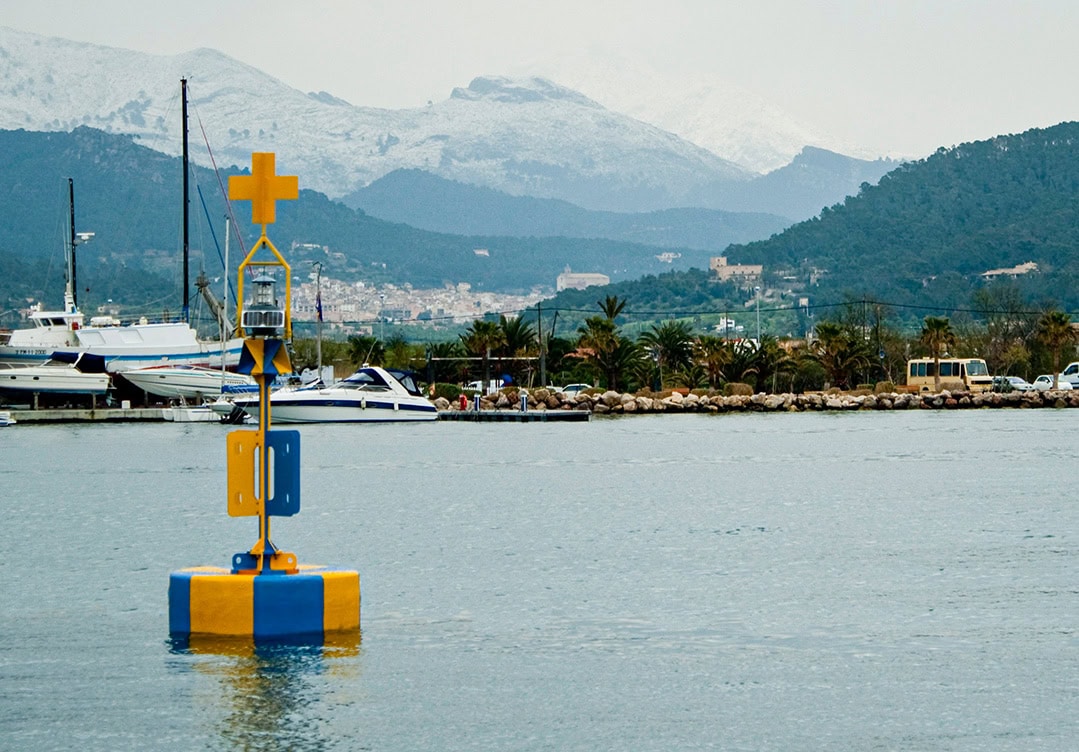
Wreck marking elastomer buoy
International regulatory framework: IMO and IALA as references
The importance of proper wreck marking is supported by the international regulatory framework. A key milestone is the Nairobi International Convention on the Removal of Wrecks (2007), promoted by the International Maritime Organization (IMO). This convention establishes a legal regime for the locating, marking and removal of wrecks that may constitute a risk to navigation or the marine environment.
Among its principles, the Nairobi Convention urges States to adopt reasonable measures to ensure the notification and proper marking of wrecks, so that navigators have clear and reliable information about the existence of new dangers.
Based on this framework, IALA developed specific recommendations and guidelines to support its members in this area (R1015 and G1046), complemented by Recommendation R1001, which describes the distinctive characteristics of marks:
- Recommendation R1015 – Marking of Dangerous Wrecks, which establishes how dangerous wrecks should be marked to ensure correct identification by navigators.
- Guideline G1046 – Response Plan for the Marking of New Wrecks, which proposes response plans for rapid and coordinated action when a new danger appears.
- Recommendation R1001 – Maritime Buoyage System, which defines the international maritime buoyage system forming the basis for correct interpretation of marks.
This regulatory framework highlights that wreck marking is not optional: it is part of a technical and operational obligation to preserve maritime safety.
Buoys and lanterns: immediate visibility in critical situations
When a wreck occurs, reaction time is decisive. The rapid installation of a wreck marking buoy equipped with a wreck marking beacon immediately warns vessels navigating in the area, even in poor visibility, heavy traffic or adverse weather conditions.
These buoys are visually characterized by equal numbers of blue and yellow vertical stripes, with a yellow cross topmark, and must be fitted with a lantern showing an alternating blue and yellow light.
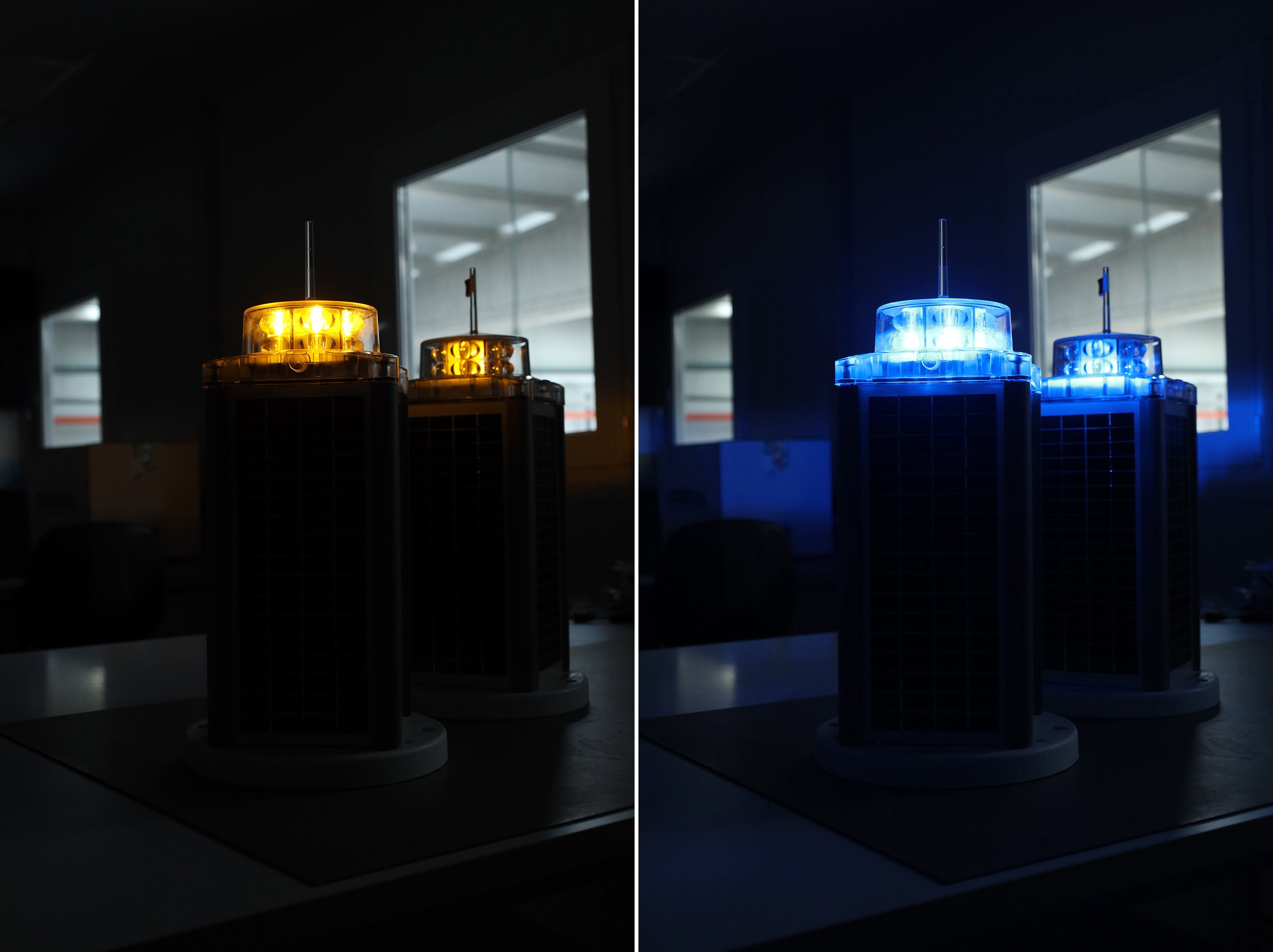
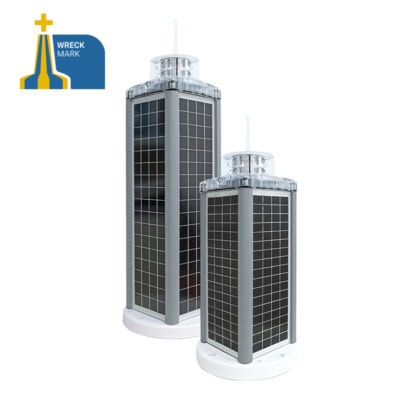
Two MCL360N-M LED lanterns for wreck marking
In this context, wreck marking lanterns play an essential role, providing luminous marking with a specific flash rhythm: blue light (1 second) and yellow light (1 second), with 0.5 seconds of eclipse between them.
As supplementary aids, a RACON or an AIS AtoN device may also be fitted.
Lanterns and supplementary aids, combined with dedicated buoys, allow authorities to:
- Identify the exact position of the hazard.
- Ensure day and night visibility.
- Facilitate chart updates and dissemination of navigational warnings.
- Reduce the risk of secondary accidents after an initial incident.
Therefore, wreck marking should form part of the contingency plans of ports, maritime authorities and infrastructure managers, who must have equipment ready for immediate deployment.
Preventive preparedness: more than a response, a strategy
Investing in wreck marking resources is not only a reaction to an incident, but a preventive strategy. The availability of wreck marking buoys and beacons helps minimize operational impacts, avoid prolonged closures of access channels and protect the institutional reputation of the responsible authorities.
Moreover, rapid action in accordance with IMO and IALA recommendations reduces exposure to claims, demonstrates technical diligence and strengthens the confidence of shipowners, port operators and port users.
From an operational point of view, it is also important that these systems are easy to store and maintain, as they normally remain in reserve until a real incident occurs.
MSM solutions for wreck marking
In this context, MSM develops specific solutions to support authorities in the marking of wrecks and new dangers.
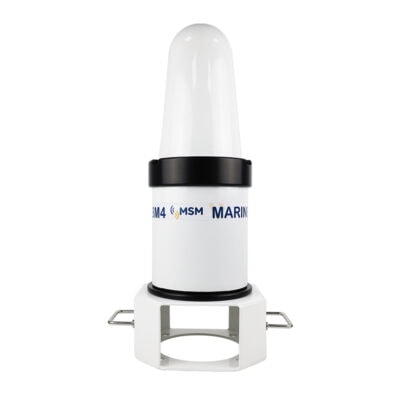
The MCL360N wreck marking lantern is designed as a standalone wreck marking beacon, equipped with LED technology, featuring an external charging port as standard, a nominal range of 6 NM, and a flash rhythm configured according to IALA R1001 alternating blue and yellow flashes. It also offers autonomy of up to 500 hours without solar charging and is prepared for multiple remote monitoring options.
Regarding floating aids, MSM provides versatile wreck marking buoys that can be adapted to different drafts and operational scenarios, facilitating their use as emergency wreck marking buoys in port environments, with a design that supports preventive storage.
The combination of buoy and wreck marking beacon offers a comprehensive solution: stable flotation and reliable luminous marking for an effective response to any new danger.

MCL360M-N wreck marking lantern
Conclusion: safety, compliance and confidence
Proper wreck marking is a cornerstone of modern maritime safety. Supported by the IMO Nairobi Convention and IALA technical recommendations, this practice protects lives, infrastructure and operations.
For port authorities and AtoN professionals, having wreck buoys, emergency beacons and response plans is not only a regulatory obligation, but an investment in safety, operational efficiency and institutional reputation.
At MSM, we work to provide technical solutions that enable fast, reliable and rigorous action when new hazards appear in the maritime environment.